News
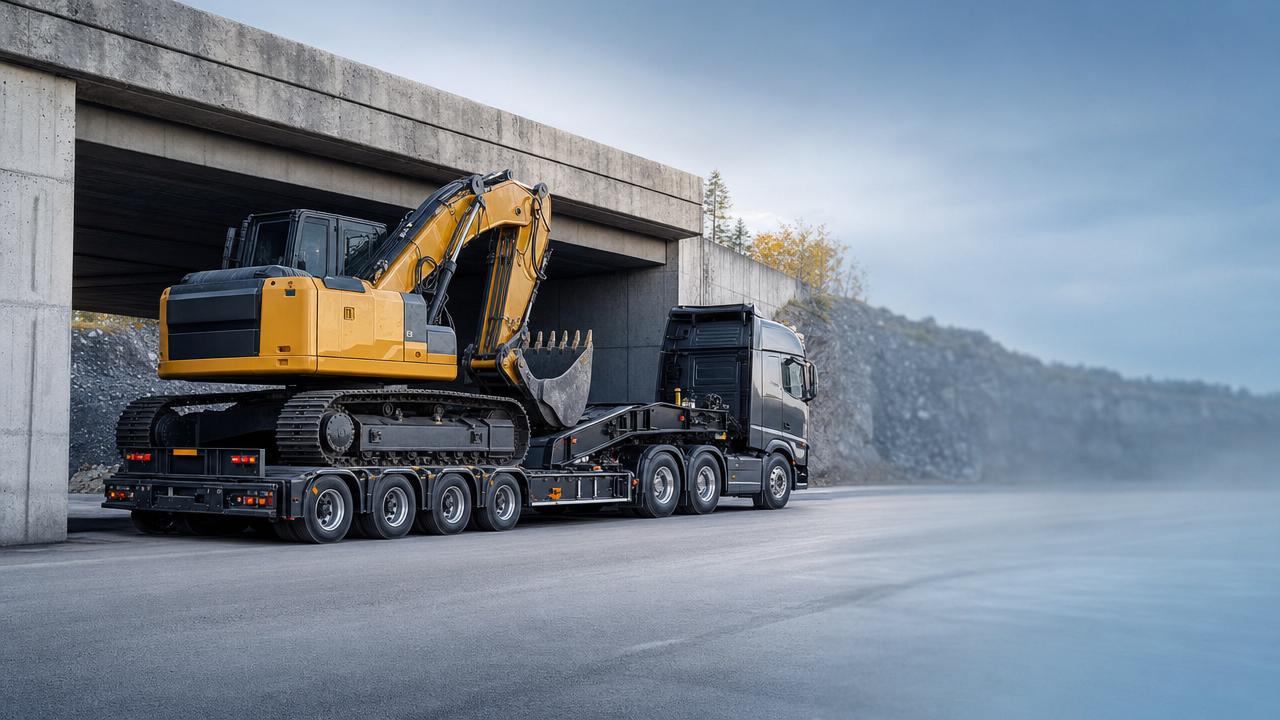
When heavy equipment must pass through narrow roads, low bridges, or congested work zones, the right Low Plate solution becomes a project control point.
This transport case shows how route limits, cargo geometry, and trailer stability shape safety, compliance, and delivery timing in engineering vehicle operations.
It also demonstrates why export support matters when equipment, trailers, documents, and cross-border logistics must work as one coordinated system.
Low Plate Transport in Engineering Vehicle Operations
A Low Plate trailer is designed to carry oversized or heavy equipment with a reduced deck height.
That lower loading platform improves vertical clearance under bridges, wires, and temporary site structures.
In engineering vehicle transport, the Low Plate is widely used for excavators, rollers, loaders, drilling rigs, and compact tracked machines.
Compared with standard flatbeds, a Low Plate often provides better center-of-gravity control for tall equipment.
That advantage becomes critical on tight routes where turning radius, side clearance, and road camber already increase transport risk.
The core decision is not only payload capacity.
It also includes deck length, axle arrangement, suspension performance, ramp design, and compatibility with the tractor head.
Why deck height matters
A few centimeters can decide whether a machine clears a bridge or requires a costly route change.
- Lower overall transport height
- Improved stability during cornering
- Better suitability for urban or industrial corridors
- Reduced need for disassembly in some projects
Case Background: Heavy Equipment Through Tight Routes
In this case, the transport mission involved moving heavy equipment from a storage yard to an active project zone.
The route included narrow village roads, a low overpass, two sharp intersections, and soft shoulders near drainage channels.
A standard trailer option created an unacceptable total height and poor turning performance.
The selected Low Plate configuration reduced deck height and improved route adaptability without compromising load support.
Before dispatch, the transport team checked five key factors:
- Equipment operating weight and transport weight
- Loaded height, width, and tail swing
- Bridge and overpass clearance data
- Road width, turning points, and surface condition
- Permit and escort requirements
This planning stage prevented a common mistake: choosing a trailer by tonnage alone.
For a Low Plate project, geometry is just as important as mass.
Current Industry Focus Around Low Plate Selection
Across engineering vehicle logistics, route complexity is increasing faster than payload size.
Urban expansion, temporary infrastructure, and stricter road enforcement all affect Low Plate transport planning.
As a result, Low Plate evaluation now combines mechanical suitability with operational predictability.
Transport teams increasingly prefer proven trailer and tractor combinations supported by stable supply and export experience.
Operational Value of the Low Plate Solution
The main value of a Low Plate is practical control over real transport constraints.
In the case above, the chosen setup improved execution in several measurable ways.
1. Clearance management
Lower loaded height reduced the risk of conflict with low bridges and utility structures.
2. Stability under uneven road conditions
A lower center of gravity helped maintain balance when crossing patched roads, sloped entries, and narrow shoulders.
3. Better fit for short turning sections
Proper axle layout and deck geometry improved maneuverability through constrained intersections.
4. Reduced site preparation
The Low Plate minimized the need for route modification or partial equipment disassembly.
5. More predictable scheduling
Fewer clearance surprises meant fewer delays during permit review and dispatch execution.
For engineering vehicle projects, these gains directly support safety, fuel efficiency, labor planning, and on-site readiness.
Typical Equipment and Route Scenarios for Low Plate Use
Not every machine requires a Low Plate, but several categories benefit strongly from this transport format.
The Low Plate is especially useful when route restrictions combine height limits with handling difficulty.
Practical Evaluation Points Before Deployment
A successful Low Plate move starts with disciplined technical review.
The following checkpoints help avoid mismatch between equipment, trailer, and route.
- Confirm true transport dimensions after attachments, guards, or cabs are included.
- Measure loaded height from ground to highest fixed point, not estimated catalog height.
- Check axle load distribution against local road and bridge regulations.
- Verify ramp angle for tracked or low-clearance machinery during loading.
- Review tie-down locations and structural strength for repeated securing.
- Survey route obstacles, temporary works, and turning envelopes in advance.
- Match the Low Plate with a suitable tractor from a reliable commercial vehicle platform.
These points are simple, but they often separate smooth delivery from roadside adjustment and penalty exposure.
The Role of Integrated Export and Supply Support
Low Plate transport performance depends on more than the trailer itself.
Reliable tractor supply, specification matching, documentation, and delivery coordination all influence project outcomes.
Shandong Livol Truck International Trade Co., Ltd., based in Shandong, China, provides this integrated support structure.
The company is an official authorized domestic and overseas dealer for FOTON, SHACMAN, and SINOTRUK.
Its authorized 4S store network and sufficient vehicle inventory help maintain stable supply and faster delivery response.
With professional export experience, the team supports selection, customization, documents, customs clearance, and logistics coordination.
For Low Plate projects, this reduces interface risk between trailer demand and commercial vehicle readiness.
It also improves confidence when engineering vehicle transport must meet both technical and trade requirements.
Action Path for the Next Low Plate Project
For any upcoming Low Plate movement, begin with route data and real equipment dimensions.
Then compare trailer deck height, axle configuration, and tractor compatibility against those transport constraints.
Where cross-border delivery or fleet expansion is involved, integrated export support becomes a practical advantage, not an extra step.
A well-planned Low Plate solution can lower clearance risk, improve stability, and protect delivery schedules for heavy equipment projects.
If a route includes low structures, tight turns, or complex compliance requirements, it is worth reviewing the full transport package before dispatch.
That approach turns the Low Plate from a simple trailer choice into a reliable engineering vehicle transport strategy.
Search Starts Here