
News
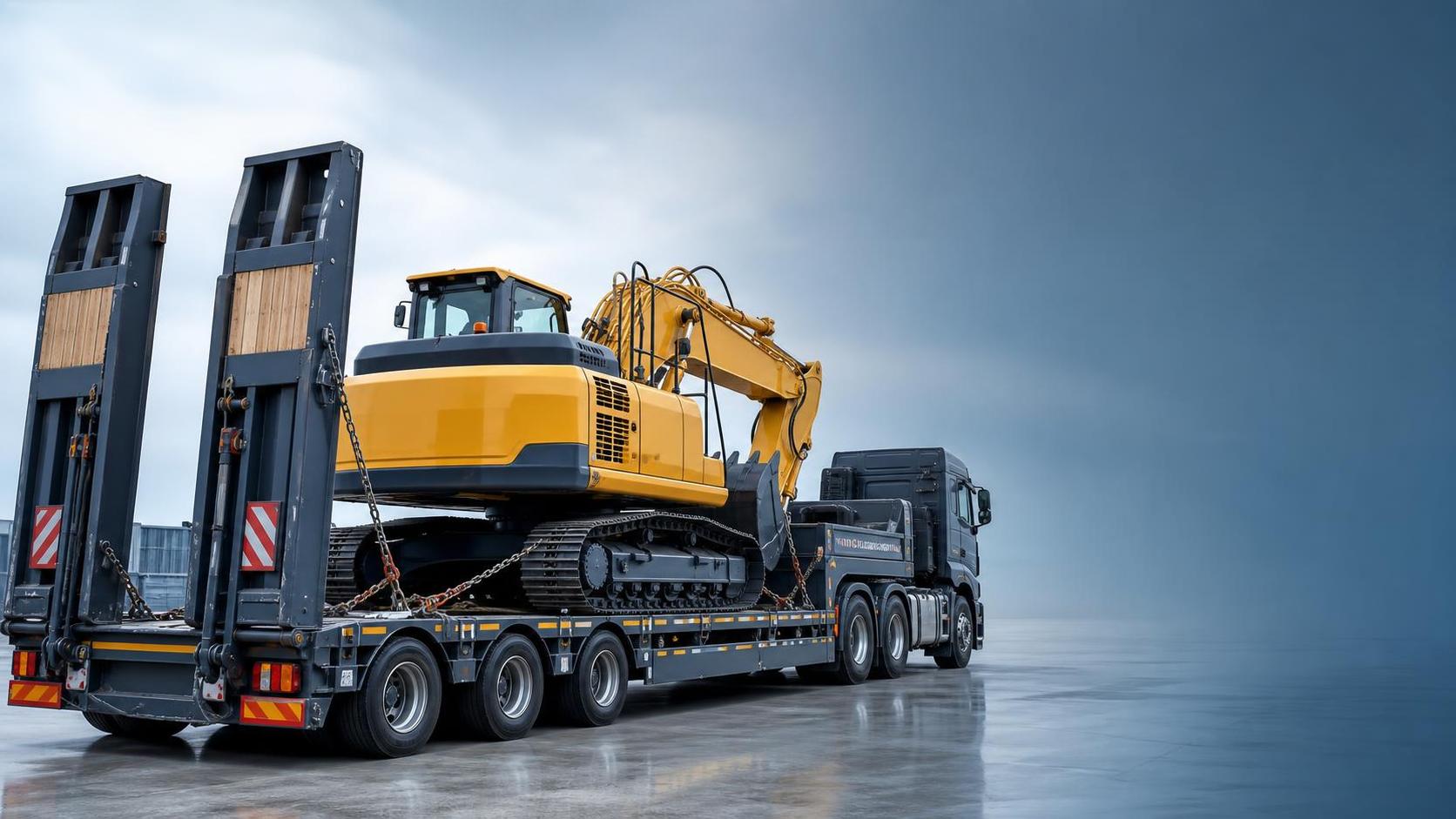
When a Low Plate Trailer Stops Being Optional
In heavy equipment transport, the question is rarely whether a machine is “large.” The real question is whether a standard flatbed or ordinary semi-trailer can carry it without creating a height violation, axle overload, or unstable center of gravity. That is the point at which a Low Plate trailer becomes necessary. In practice, it is not chosen because the cargo looks oversized. It is chosen because the transport envelope, load distribution, and road compliance no longer leave enough safety margin for a conventional deck height.
A Low Plate trailer is generally understood in the industry as a trailer built with a lower loading deck to reduce overall loaded height and improve stability for heavy or tall equipment. This matters most for excavators, rollers, drilling units, transformers, construction machinery with fixed upper structures, and other cargo that cannot be easily dismantled. Once the combined height of trailer plus equipment approaches legal road limits, deck height becomes a compliance issue, not a convenience feature.
That distinction is important for quality control and safety management. A transport plan can fail even when the machine weight is within the trailer’s nominal capacity. Height restrictions on bridges, overhead utilities, tunnel entries, and cross-border checkpoints often become the limiting factor before gross weight does. A machine that fits on paper by tonnage may still require a Low Plate arrangement because the upper structure sits too high, the boom cannot be lowered enough, or the cargo footprint concentrates weight in a way that makes a higher deck unsafe during braking or cornering.
The Core Decision Is Geometry, Not Just Capacity
One of the most common misunderstandings is to treat trailer selection as a simple tonnage match. Transport teams ask whether the trailer is rated for 40 tons, 60 tons, or more, and stop there. That is incomplete. In real operations, a low-deck configuration is often driven by three combined checks: loaded height, axle load distribution, and dynamic stability.
Loaded height is the first filter. Every jurisdiction has its own road rules, permit thresholds, and enforcement practices, so there is no universal figure that can be safely assumed. What matters is the method: measure the true transport height from the road surface to the highest fixed point after loading, suspension settling, and securement. Foldable attachments, removable guard frames, and tire pressure conditions can change the result. If the machine only clears the route on a conventional trailer under ideal assumptions, that is not a strong transport plan. A Low Plate trailer buys back height margin where it is most valuable.
The second check is axle loading. Some equipment is deceptively compact but places a large proportion of mass over a short contact length. Pavers, compactors, and tracked machines can overload part of the trailer deck or concentrate force over limited axle groups. A lower trailer designed for heavy equipment transport usually does more than reduce deck height. It can also provide a more suitable load path, stronger structure, and axle arrangement better aligned with permit and road protection requirements.
Then there is dynamic behavior. Tall machinery on a high deck is less forgiving in emergency lane changes, uneven site exits, and mountain or port access roads. Safety managers already know this from lifting operations: a center of gravity does not become less critical simply because the load is tied down. Lowering the cargo platform reduces rollover tendency and improves the vehicle’s behavior under crosswind, braking, and uneven pavement inputs.
Situations Where a Low Plate Trailer Is Commonly Required
The clearest case is tall equipment that cannot be practically disassembled. Many machines are technically separable, but field reality matters. Removing components may require factory tools, affect commissioning schedules, introduce reassembly risk, or create separate packing and customs complications. In those cases, lowering the transport deck is often more realistic than breaking the machine into transport units.
Another common case is equipment with a high center of gravity relative to its base width. This includes machinery with towers, enclosed operator structures, elevated tanks, or asymmetrical upper assemblies. Even if total height is still legal, the transport may still justify a Low Plate trailer because stability margins on ordinary roads are too tight for routine movement.
Heavy tracked machinery also tends to push the decision in this direction. Tracks create concentrated bearing pressure and loading geometry that standard trailers do not always manage well. A purpose-suited low trailer can help keep the machine lower, distribute load more effectively, and improve loading angle during drive-on or winch-on operations. That last point is easy to underestimate: the wrong loading angle can damage undercarriage components or create a dangerous transition point at the rear ramp.
Cross-border projects add another layer. Transport that passes through multiple regulatory environments often needs more conservative planning because enforcement tolerance, permit handling, escort requirements, and dimensional triggers are not identical from one country to another. Companies involved in export logistics learn quickly that a trailer choice that works domestically may cause avoidable delay at a border if overall dimensions leave no operational buffer.
A Practical Screening Framework
Before assigning a trailer, it helps to screen the cargo through a few operational questions:
- What is the final loaded height from road surface to highest fixed point?
- Does the machine’s center of gravity sit unusually high or off-center?
- Will axle group loads remain compliant after actual positioning, not theoretical positioning?
- Can the equipment be safely loaded and unloaded without excessive ramp angle or underbody contact?
- Does the route include bridges, tunnels, power lines, site gates, or temporary works that reduce height clearance?
- Are there permit, escort, or customs implications if dimensions exceed standard transport thresholds?
If several of these questions produce narrow margins, a Low Plate trailer is usually the more defensible choice. Not because it is the only possible option, but because it reduces exposure across multiple failure points at once.
Where People Misjudge the Boundary
A frequent mistake is assuming that permits will solve everything. Permits can authorize an exceptional movement, but they do not correct poor load stability or weak loading geometry. They also do not guarantee route feasibility if the selected trailer leaves almost no clearance. Another mistake is treating “heavy” and “oversized” as interchangeable. Some cargo is extremely heavy but low and stable, which may point toward a different trailer configuration. Other cargo is not exceptionally heavy, yet still requires a Low Plate setup because height is the controlling risk.
There is also a documentation problem. Equipment dimensions in brochures are often shipping references or machine dimensions in parked condition, not verified transport dimensions with accessories, guards, optional tires, or mounted tools. Quality teams should insist on actual measured values before dispatch. The difference between catalog height and loaded height can be enough to change the trailer class.
Why This Matters in Export and Fleet Quality Control
For companies handling international commercial vehicle supply and project equipment movement, trailer selection is tied directly to delivery reliability. Shandong Livol Truck International Trade Co., Ltd., working as an authorized dealer for FOTON, SHACMAN and SINOTRUK and supporting full-process export services, operates in the part of the business where logistics decisions are not abstract. Vehicle specification, available stock, shipping arrangement, customs documentation, and route practicality all interact. A mismatch between equipment profile and trailer type can affect not only road safety but loading schedules, customs declarations, and final handover timing.
That is why experienced exporters and fleet managers do not isolate the trailer from the rest of the transport chain. They look at whether the receiving market has route restrictions, whether the cargo will move directly to project site after discharge, whether local operators can handle special loading procedures, and whether after-sales support may be needed if partial disassembly is chosen. In many cases, using a Low Plate trailer early in the planning stage simplifies the entire movement even when it appears more specialized at first glance.
No Universal Rule, but a Clear Industry Logic
There is no single global threshold that automatically declares a Low Plate trailer mandatory for every transport task. Legal dimensions, axle regulations, and permit systems differ too much for that. Still, the industry logic is consistent: once equipment height, center of gravity, axle concentration, or loading angle begins to erode normal operating margin, the lower trailer deck stops being a preference and becomes part of risk control.
For safety and quality personnel, the right approach is not to ask, “Can this machine be moved on a standard trailer?” but “What trailer configuration leaves adequate compliance and safety margin for the actual route, actual machine condition, and actual loading method?” That shift in wording usually leads to better decisions. A Low Plate trailer is required when ordinary trailer geometry pushes the transport too close to legal or operational limits. In heavy equipment movement, that margin is where most of the real judgment sits.
Search Starts Here