
News
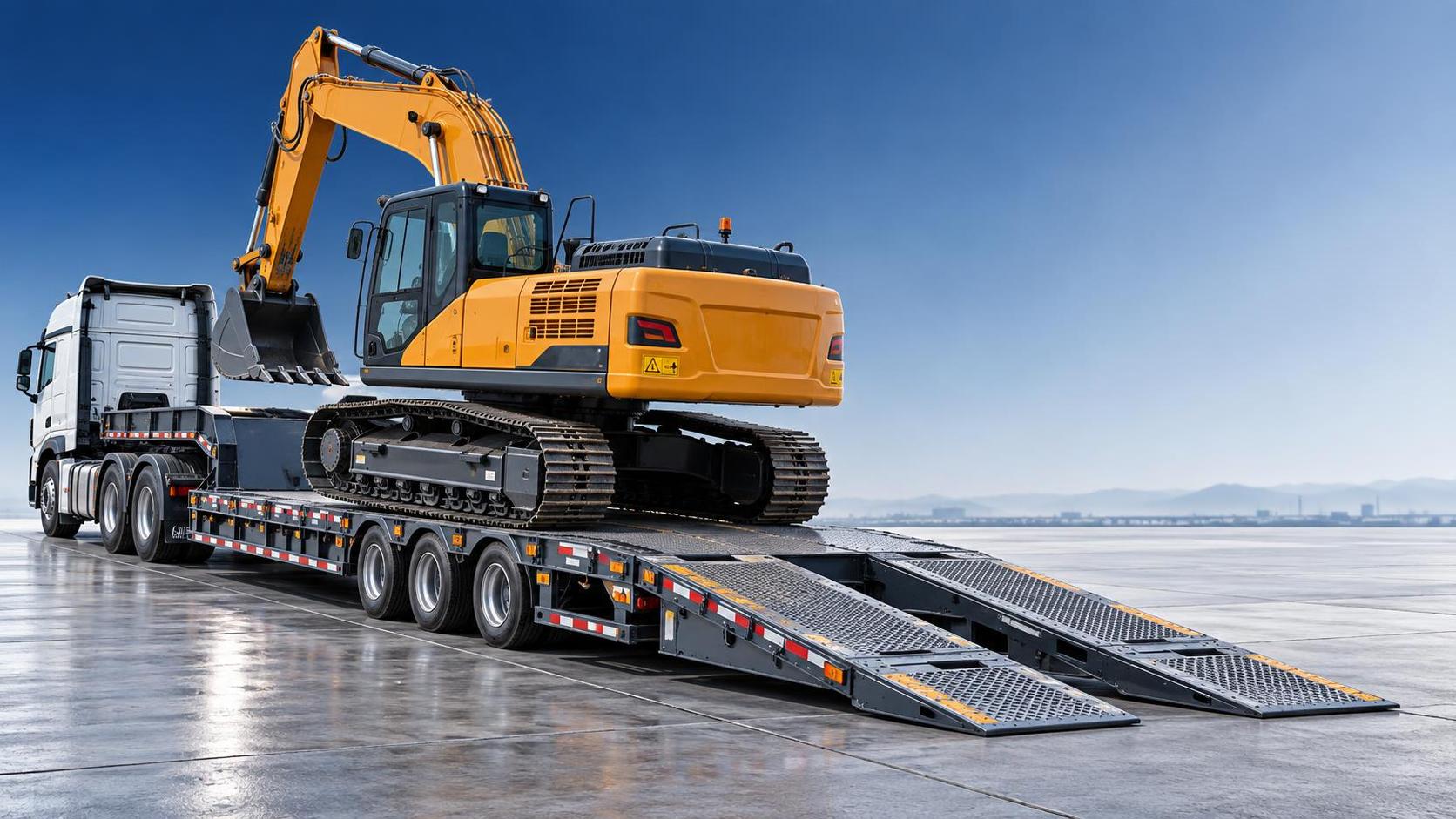
Moving an excavator, wheel loader, road roller, or drilling rig often becomes difficult before the machine even reaches the trailer. The problem is usually the transition from ground level to deck level. When the deck sits high above the ground, the loading ramps must be steeper, longer, or both. Operators may have limited space to deploy them, poor ground conditions at the loading point, and little margin for error when a machine’s tracks, tires, bucket, or undercarriage approach the ramp edge.
A Low Plate trailer reduces this problem by placing its cargo platform closer to the ground. The lower deck does not eliminate the need for careful loading, but it decreases the vertical climb required to get machinery onto the trailer. In practical terms, this can reduce ramp angle, improve machine approach, lower the chance of grounding, and make it easier to stay within transport-height limits. The benefit comes from the geometry of the trailer, not simply from having a lower-looking vehicle.
Why loading height creates real operating problems
Heavy machinery is not designed to climb steep ramps in the same way as a road vehicle. A crawler excavator may have limited traction when its tracks meet a wet steel surface. A loader can shift weight sharply to the rear or front as it climbs. Equipment with a long wheelbase may high-center at the point where the ramp meets the deck. Low-clearance machinery can strike the ramp transition, while attachments may reduce the operator’s forward view.
These problems become more serious in temporary work areas. A loading location may be uneven, muddy, narrow, or shared with other equipment. The operator may need to load beside a road, within a quarry, on a construction site, or at a yard where there is not enough room to use unusually long ramps. Raising the trailer deck by even a modest amount can force a steeper approach, and a steeper approach increases the effect of every surface irregularity.
A lower cargo deck changes the starting point of the entire loading operation. The machinery still needs suitable ramps, secure ground support, and proper restraint after loading, but the machine has less vertical distance to climb. That gives operators more room to control speed, alignment, and weight transfer.
How a lower deck changes ramp angle
The relationship is straightforward: for a ramp of a given length, a lower deck creates a lower angle. Conversely, if the desired ramp angle is fixed, a lower deck allows the use of a shorter ramp. Both outcomes can be useful, depending on the job site.
Ramp angle matters because it affects traction, clearance, and machine stability. A shallow angle creates a smoother transition between ground and trailer. Tracks and tires remain in contact with the ramp more evenly, and the machine is less likely to pitch suddenly as it reaches the deck. The operator can also maintain a slower, more controlled approach without fighting a large change in machine attitude.
Lowering the deck does not mean every machine can use a short ramp safely. Ramp selection still depends on the machine’s operating weight, track or tire configuration, ground clearance, approach angle, center of gravity, and the condition of the ramp surface. However, the lower deck gives the loading setup a more forgiving starting point.
The deck height is only one part of the loading path
Operators sometimes focus only on the advertised deck height and overlook the full path the machine must travel. The actual loading angle depends on more than the trailer platform. Ground elevation, ramp position, suspension behavior, tire deflection, ramp support, and the transition from ramp to deck all affect the result.
For example, a trailer parked with its rear end lower than the loading surface may produce a gentler approach than the same trailer positioned on a slope in the opposite direction. Soft ground under the ramp can also change the angle after the machine begins climbing. If ramp feet sink or shift, the loading path can become unstable even though the trailer deck itself is low.
The ramp-to-deck transition deserves close attention. A low plate design may reduce the overall climb, but a sharp lip at the top of the ramp can still create a strike point for machines with low belly clearance or long track frames. Some equipment is especially sensitive to this breakover point. The correct question is not only “How high is the deck?” but also “Can this machine travel from ground to deck without losing clearance, traction, or alignment?”
Machinery types that gain the most from reduced loading height
Low deck trailers are particularly useful when equipment has limited clearance or must be loaded frequently. Crawler excavators are a common example because track contact, machine balance, and attachment position must all be controlled during loading. A gentler ramp approach can make it easier to keep the tracks centered and reduce abrupt forward or rearward pitching.
Compact excavators, skid steer loaders, compact track loaders, and small rollers can also benefit, especially where loading space is tight. Their smaller size does not automatically make them easier to load. Short wheelbases, attachment overhang, and uneven ramps can create sharp changes in balance. A low deck can reduce these transitions, although the equipment must still be positioned according to its operating manual and loading procedure.
For wheeled machines such as backhoe loaders, telehandlers, or wheel loaders, the relevant concerns may include axle loading, tire grip, approach angle, and articulation. A flatter climb helps reduce sudden weight transfer, but operators should consider the machine’s steering mode and attachment position. Articulated machines should normally be aligned straight before climbing unless the equipment manufacturer specifies otherwise.
Tall machinery also benefits in a different way. Once loaded, a low deck can reduce total transport height. This may be important for equipment with high cabs, booms, masts, protective structures, or fixed attachments. The transport height must still be measured after the machine is secured, including any raised components, exhaust stacks, beacon mounts, or accessories. A low trailer is not a substitute for confirming clearance on the planned route.
Choosing a Low Plate configuration for the machine, not just the load weight
Payload rating is essential, but it is not enough to choose a trailer based only on machine weight. The deck length, axle arrangement, ramp capacity, deck width, gooseneck or front structure, and tie-down layout must also suit the machinery being moved. A machine may be within the rated payload yet still be poorly matched to the available loading angle or usable deck space.
Before selecting a trailer configuration, identify the machine’s transport dimensions and loading characteristics:
- Operating or transport weight, including attachments that will remain installed.
- Overall length, width, height, and the position of the machine’s center of mass.
- Ground clearance and the lowest point likely to pass over a ramp transition.
- Track width, tire width, and the required clearance from ramp edges.
- Approach and departure geometry, especially for wheeled equipment.
- Whether the boom, bucket, blade, forks, or other attachment changes loading balance.
- Expected loading surfaces, including paved yards, compacted soil, slopes, and confined sites.
Deck width is often overlooked until the machine reaches the ramp. Tracks or tires should have sufficient bearing surface across the ramp and deck. A machine loaded too close to one side may create uneven trailer loading and leave inadequate space for safe inspection or access to tie-down points. Where machinery is wider than the main deck, the selected trailer must be suitable for that width and for the applicable transport requirements.
A practical loading sequence that uses the lower deck effectively
Reduced loading height is most useful when the trailer is prepared correctly. A rushed setup can remove the advantage of the lower deck and create avoidable risk.
- Choose stable, reasonably level ground. Avoid loading where one ramp will sit on loose fill, deep mud, broken pavement, or a pronounced side slope. The trailer and ramps need a stable base before the machinery begins moving.
- Set the trailer in its loading condition. Apply the required parking controls, deploy supports where fitted and appropriate, and make sure the trailer cannot move during loading. Follow the trailer manufacturer’s procedures for any air suspension, hydraulic system, or ramp mechanism.
- Inspect ramps and their contact points. Confirm that ramps are fully seated, locked or supported as intended, and free from loose soil, oil, ice, or debris. Check that the ramp width matches the machine’s tracks or tires.
- Plan the machine position before climbing. Determine where the machine must sit on the deck to distribute weight properly and leave room for restraints. Do not rely on repositioning repeatedly after reaching the deck, particularly in limited space.
- Load slowly and in a straight line. Keep the machine centered on the ramps. Sudden steering, turning on narrow ramps, rapid acceleration, or abrupt braking can shift the machine away from the intended path.
- Stop and assess the transition. As the machine reaches the deck, watch for contact beneath the chassis, attachment interference, or a sudden change in pitch. If the transition is not smooth, unload safely and correct the setup rather than forcing the machine over it.
- Secure the machine after final positioning. Lower attachments as appropriate, apply the machine’s parking controls, and use properly rated restraint equipment at suitable anchor points. Restraint procedures should match the machine, trailer, and local transport requirements.
Problems a low deck cannot solve by itself
A lower platform improves loading geometry, but it does not correct poor ramp condition, unsuitable ground, overloaded axles, or incorrect load distribution. It also cannot prevent a tall machine from exceeding route-clearance limits if the machine is configured improperly for transport.
One recurring issue is assuming that a low deck makes any attachment position acceptable. An excavator bucket left in an unsuitable position can still affect balance or create an overhang problem. A loader bucket, forks, or blade may alter the machine’s center of gravity as it climbs. Equipment should be prepared according to the manufacturer’s transport guidance, with booms, arms, attachments, articulation locks, and travel controls managed as required.
Another mistake is using the deck height as the only comparison point between trailers. A trailer with a slightly higher deck but better ramp design, stronger ramp support, more usable deck length, or a smoother transition may be the better match for a specific machine. The correct choice depends on the entire loading system rather than a single measurement.
Signs the loading setup should be changed
Stop and reassess when tracks or tires approach the ramp edges, the machine scrapes at the ramp-to-deck breakover point, the ramps flex excessively, or the trailer shifts as weight transfers onto it. Excessive wheel spin, track slip, uneven ramp contact, and visible ground settlement are also warnings that the loading surface or ramp arrangement is not adequate.
Do not compensate for an unsuitable angle by increasing speed. Momentum can make a machine cross a transition, but it reduces control precisely when the load is changing position. A better response may be to reposition the trailer on firmer ground, use an appropriate ramp arrangement, remove or reposition an attachment when permitted, or select a lower and more suitable trailer configuration.
When a machine has unusual dimensions, very low clearance, high transport height, or a heavy attachment, verify the proposed loading arrangement before transport. A properly matched Low Plate trailer can reduce loading height substantially, but its value is realized only when deck geometry, ramps, ground conditions, machine position, and load restraint are treated as one connected operation.
Search Starts Here