
News
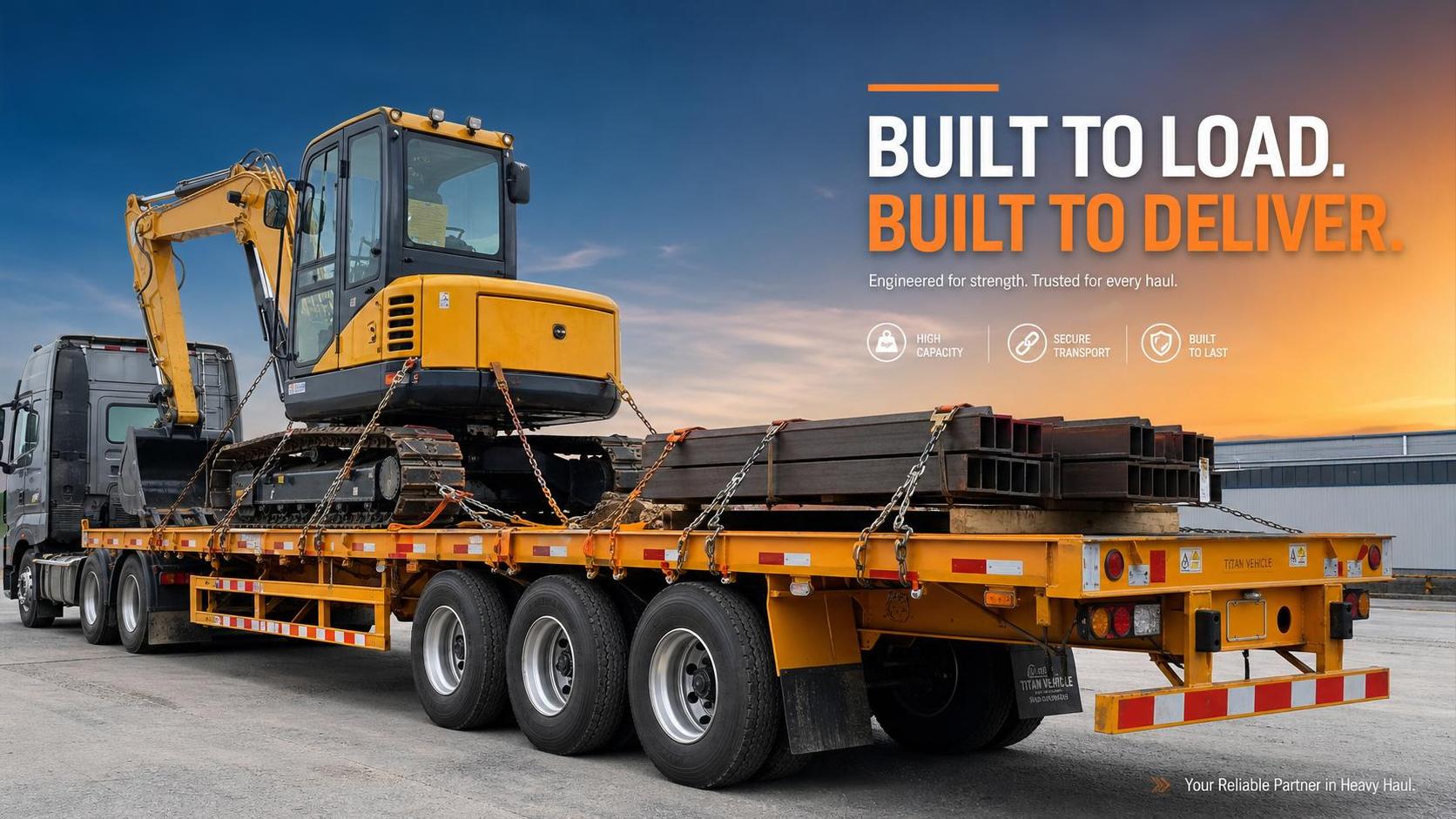
A Flatbed Semi-Trailer is one of the most practical transport tools in construction logistics, heavy equipment movement, and oversized cargo delivery. Its open deck makes loading easier, but that same flexibility creates risk when load limits are misunderstood or cargo is tied down without a clear securing plan.
For road safety, cargo protection, and legal compliance, load control matters as much as engine power or axle strength. In daily operations, small mistakes in weight distribution or tie-down selection can lead to damaged machinery, unstable braking, and serious transport incidents.
This is especially relevant in the engineering vehicle sector, where excavators, steel structures, concrete components, pipes, timber, and large machinery often travel on a Flatbed Semi-Trailer. The job rarely involves uniform cargo, so each trip requires practical judgment rather than routine loading alone.
Why load limits are more than a number on paper
Load limits define how much weight a trailer can carry safely, but the real issue is not only total mass. A Flatbed Semi-Trailer must also handle where the weight sits, how it moves, and how it affects the tractor, suspension, axles, tires, and braking distance.
In practice, overloading is not always obvious. A load may stay within gross weight limits while still creating unsafe axle pressure. A machine positioned too far forward can overload the kingpin. Too far back, and steering stability may suffer.
That is why operators usually look at three things together: legal weight, trailer design capacity, and actual load balance. Treating only one of these as the decision point often causes problems later on the road.
The key limit categories to check
The following reference points are basic, but they shape nearly every safe loading decision on a Flatbed Semi-Trailer.
These checks become even more important when moving construction machinery or fabricated steel, because the center of gravity is often high, uneven, or offset.
How tie-down basics shape transport safety
Tie-downs are not just straps added at the end of loading. They are part of the cargo restraint system. On a Flatbed Semi-Trailer, the restraint plan should match the cargo weight, shape, friction level, and expected road forces.
When a truck brakes hard, cargo keeps moving forward. During cornering, lateral force pushes it sideways. On rough roads, vertical bounce reduces tension and can loosen weak securing points. Good tie-down practice exists to control all three directions.
Main restraint methods in daily use
- Direct tie-down: secures cargo by attaching restraints directly to the load and trailer anchor points.
- Friction tie-down: uses strap tension to increase pressure and reduce movement across the deck.
- Blocking and bracing: adds physical barriers, chocks, or supports to stop rolling or sliding.
- Chain securement: often preferred for heavy machines, tracked equipment, and compact high-mass cargo.
A single method may work for light bundled cargo, but engineering loads often need a combination. For example, a wheeled machine may require wheel chocks, chain tie-downs, and attachment point checks before departure.
What usually goes wrong
Most securing failures do not start with broken parts. They begin with poor assumptions. A strap may be rated correctly, but used at the wrong angle. A deck may look clean, but oil or mud lowers friction. A strong chain may be attached to a weak anchor point.
Another frequent issue is uneven tension. If one side takes most of the load, the cargo can rotate under braking or bounce loose on uneven pavement. Rechecking tension after the first part of the trip is a simple habit with real value.
Typical cargo scenarios on a Flatbed Semi-Trailer
Different cargo types create different securing logic. That is why experienced transport teams do not treat every Flatbed Semi-Trailer load as a standard shipment.
Construction machinery
Excavators, loaders, rollers, and similar equipment usually have concentrated weight and defined securement points. The key concerns are axle placement, machine orientation, boom or arm restraint, and movement caused by vibration.
Steel, rebar, and long materials
These loads can shift lengthwise if bundling is weak. Edge protection also matters, because sharp corners can damage webbing. Longer cargo may need extra attention to overhang rules and support spacing across the deck.
Palletized industrial goods
This category looks easier, but poor stacking creates hidden instability. If the upper layers are soft or uneven, strap pressure may compress the cargo and reduce tension later in transit.
Pipes, timber, and cylindrical cargo
Rolling risk becomes the main issue here. Chocks, cradles, and side restraint are essential. On a Flatbed Semi-Trailer, round cargo should never rely on tension alone.
Choosing the trailer with load control in mind
Safe transport starts before loading day. Trailer selection affects what can be carried, how it can be secured, and how efficiently routes can be planned. A Flatbed Semi-Trailer that suits one cargo profile may not fit another.
Deck length, axle configuration, suspension type, floor structure, and anchor point design all influence usability. In engineering transport, these details matter because cargo is rarely identical from one project to the next.
This is where supply experience becomes useful. Shandong Livol Truck International Trade Co., Ltd. works with FOTON, SHACMAN, and SINOTRUK commercial vehicle resources and supports customers with vehicle selection, customization, export documents, customs handling, and logistics coordination.
That background matters because trailer choice is often connected to the full transport system, not the trailer alone. Tractor compatibility, road regulations, spare parts access, and after-sales support all affect long-term operating reliability.
Practical checks before every trip
A reliable routine is usually more effective than a long checklist that nobody uses well. Before dispatching a Flatbed Semi-Trailer, a focused inspection should cover the points most likely to affect movement, control, and compliance.
- Confirm cargo weight from accurate documents, not estimates.
- Check axle distribution after positioning the load.
- Inspect deck condition, friction surface, and anchor point integrity.
- Match chains, straps, binders, and protectors to the load type.
- Secure movable machine parts, attachments, or accessories separately.
- Review route clearance, turning limits, and permit requirements.
- Reinspect tie-down tension after the first distance interval.
These checks are straightforward, but they build the foundation for safer transport. In most cases, incidents come from skipped basics rather than complex technical failures.
What deserves closer attention next
For anyone reviewing a Flatbed Semi-Trailer setup, the next step is to compare actual cargo patterns with trailer specification, securement equipment, and route conditions. That often reveals whether the current arrangement is simply workable or genuinely dependable.
It also helps to standardize tie-down practices around the loads moved most often. Repeated cargo categories benefit from repeatable loading positions, fixed inspection points, and equipment matched to known weight ranges.
Where transport crosses borders or involves mixed fleet requirements, it is worth reviewing specification support, spare parts access, and delivery coordination alongside the trailer itself. A Flatbed Semi-Trailer performs best when the equipment choice, securing method, and operating process are aligned from the start.
Search Starts Here